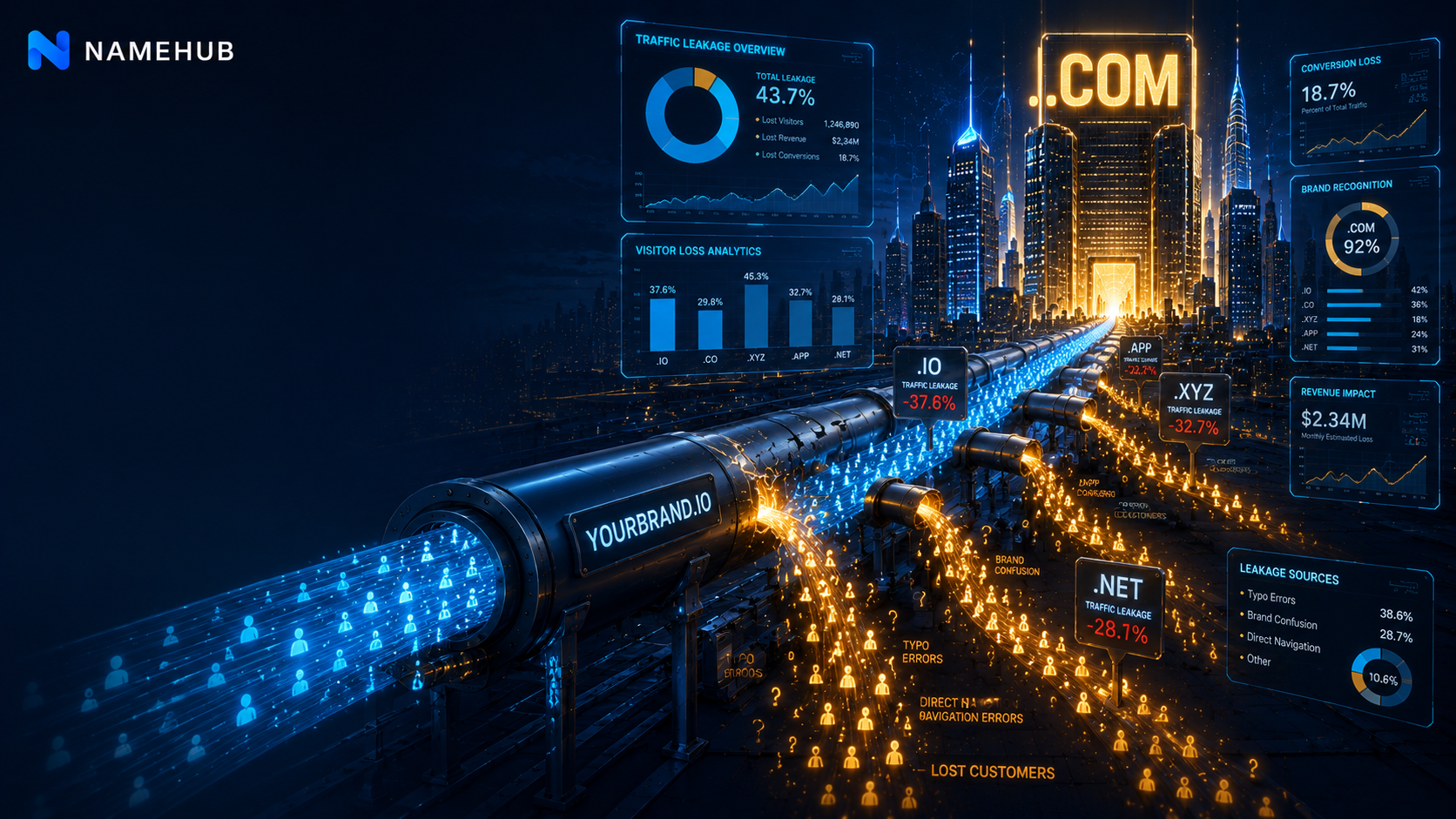
NameHub Conversion Blueprint
When assessing the price of a premium domain name, many executives look exclusively at the upfront acquisition cost. This is an expensive mistake. By looking only at the price tag of the asset, you completely miss the invisible, compounding economic drag known as Traffic Leakage. Operating your business on a secondary extension (like .co, .net, or .io) acts as a progressive tax on every dollar you pour into marketing. The NameHub team pulls back the curtain on the mathematics of domain leakage so you can audit your own metrics and see exactly how much capital your extension is costing your bottom line.
The Anatomy of a Broken Marketing Funnel
01. Understanding the Hidden Friction Point
Traffic leakage occurs because of decades of human behavioral conditioning. For over 30 years, consumers have been hardwired to believe that the internet ends in .com. It is a deeply ingrained physiological habit.
When you run a podcast ad, sponsor a major newsletter, pass out business cards, or generate organic word-of-mouth buzz, your prospects don't click a raw link—they type your brand name into their browser. If your name is Acme.io, a massive subset of your audience will naturally type Acme.com. If that premium .com address leads to a broken page, a domain broker's landing page, or worse, a direct industry competitor, you have actively spent your marketing budget to acquire a customer for someone else.
II. The Formula: Auditing the Annual Financial Waste
Let’s take look at the real-world math behind running a business on a secondary domain. This formula shows how scaling your company without upgrading your domain turns an upfront savings into a permanent, draining expense.
| Metric Component | Mid-Sized Startup Data |
|---|---|
| Annual Direct Marketing Spend (PPC, SEO, Ads) | $250,000 USD |
| Baseline Traffic Leakage Rate (Conservative 15%) | 15% |
| Annual Marketing Capital Wasted directly on Leakage | $37,500 USD |
| Realized 4-Year Accumulative Capital Loss | $150,000 USD |
Operational Context: This chart completely excludes the lifetime value (LTV) of lost clients, meaning the true economic impact is significantly higher.
03. The Hidden Tax on Customer Acquisition Cost (CAC)
When traffic leakage happens, your Customer Acquisition Cost (CAC) inflates automatically across every single marketing channel. If your ad campaigns drive 10,000 high-intent prospects to manually type your URL, but 2,000 of them mistype it into a dead .com placeholder, your effective acquisition cost has climbed by exactly 20%.
You are forced to work harder, spend more, and deploy more ad campaigns just to compensate for a leaky bucket. Buying your premium exact-match .com or category-defining tech extension isn't an ego play—it's a infrastructure optimization choice that permanently plugs the leak, bringing your CAC down to its optimal baseline efficiency.
🕵️♂️ NameHub Professional Audit: Is Your Brand Bleeding Out?
Want a quick way to diagnose if your business is currently losing traffic to an extension typo? Open your analytics dashboard and look at your **Direct Navigation Traffic** trends during a major marketing campaign or PR launch.
If your brand searches spike on Google but your direct type-in traffic stays flat, a significant portion of your users are trying to find you via default extensions and getting lost along the way. Securing your matching premium domain acts as an permanent insurance policy for your brand's digital identity.
The Strategic Verdict: Plug the Leak
Renting traffic through continuous PPC bids while ignoring a leaky brand funnel is an inefficient way to run an enterprise. Upgrading to your definitive digital address is a structural adjustment that pays dividends for the entire lifetime of your company. Secure your core asset, protect your marketing spend, and stop giving away your traffic.
Verified Analytical Disclosures
- Web Analytics Association & Consumer Behavior Logs: Comparative behavioral studies tracking manual address entry errors and direct-type misrouting metrics.
- NameHub Business Case Studies: Aggregated, real-world data measuring client customer acquisition rate improvements following a secondary-to-premium domain upgrade.
- Google Ads Performance Benchmarks: Historical data indexes mapping landing page URL structure trust variables directly to baseline ad quality scores.


Leave a Comment